The Digital Habits of People Who Seem Calm Online
G
Gilbert Ellis


Some people seem to have discovered a version of the internet the rest of us somehow missed. They use social media, answer messages, follow the news, and participate in group chats, yet they do not appear to be permanently overwhelmed by any of it. They are not announcing a digital detox every three months or deleting every app from their phone. They simply seem to have boundaries around technology that keep it from occupying every available corner of their attention.
Being calm online is not necessarily about spending dramatically less time on the internet. It is often about using that time more deliberately. The people who seem least consumed by their digital lives tend to have a few habits that prevent every notification, headline, argument, and message from becoming something that requires an immediate reaction.
One of the simplest differences is that calm digital users do not respond to every notification the moment it appears. A message can sit unanswered for an hour. An email can wait until the appropriate part of the workday. A social media notification may never be opened at all. They understand that receiving information and responding to information are two separate events.
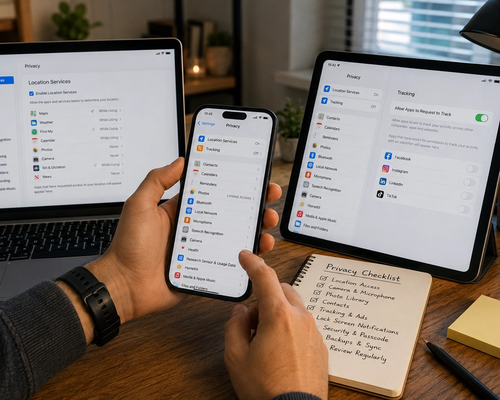
This is easier when notifications are controlled rather than accepted as part of owning a phone. People who protect their attention often disable alerts from shopping apps, games, social networks, news services, and anything else that does not genuinely need immediate access to them. Important people can still reach them, but every app on their phone does not get equal permission to interrupt dinner, work, sleep, or a conversation.
The result is subtle but powerful. Instead of spending the day reacting to their devices, they decide when they want to engage with them.
Digital communication has created an unusual expectation of availability. Someone can see that a message was delivered, perhaps even that it was read, and suddenly a perfectly ordinary delay can feel socially significant. This encourages people to answer messages while working, eating, walking, watching television, or spending time with someone else.
Calmer online habits involve accepting that not every conversation needs to happen in real time. People reply when they have the time and attention to do so. They also tend to extend the same generosity to others. A friend taking several hours to answer is not automatically interpreted as rejection. A colleague being offline does not become a mystery that needs solving.
Removing the expectation of constant responsiveness makes digital communication feel much less demanding. Messages become something to return to rather than a queue that must constantly be cleared.
The internet offers an unlimited supply of things to disagree with. If you wanted to spend your entire day correcting strangers, defending your opinions, and reading increasingly angry replies, you could easily do it.
People who seem calm online are usually selective about when they participate. They recognize that being able to respond does not mean responding will accomplish anything. Before entering a debate, they are more likely to consider whether the conversation is genuinely useful, whether the other person seems interested in discussion, and whether they actually want to spend their evening thinking about it.
Sometimes they write a response and delete it. Sometimes they mute the conversation. Sometimes they keep scrolling. This is not necessarily avoidance. It is recognizing that attention is limited and not every disagreement deserves a portion of it.
Your online experience is partly shaped by what you repeatedly allow into it. Follow hundreds of accounts built around outrage, comparison, controversy, and bad news, and opening your phone will predictably feel different from following people and publications you genuinely enjoy.
Calm digital users tend to curate without much guilt. They unfollow accounts that consistently make them irritated or insecure. They mute people when unfollowing would create unnecessary social awkwardness. They leave groups that stopped being useful and unsubscribe from emails they never read.
This does not mean constructing an online world in which nobody disagrees with you. Encountering different ideas is valuable. The distinction is between information that challenges you and content that repeatedly makes you feel worse without giving you anything meaningful in return.
Your feed may be generated by an algorithm, but your behavior still teaches that algorithm what to give you more of.
Following current events is important. Refreshing the news every fifteen minutes rarely makes you significantly better informed.
People with calmer digital habits often have some separation between staying informed and continuously monitoring what is happening. They might read the news in the morning, listen to a daily podcast, or check a few trusted sources at particular times rather than following every development as it unfolds.
This becomes especially important during major breaking stories, when information changes quickly and speculation spreads alongside verified reporting. Constant updates can create the feeling that watching closely gives you some control over events when, in reality, you are often receiving the same information repeatedly.
You can care deeply about what is happening without carrying a live news feed in your head all day.
Social media makes comparison almost effortless. Someone announces a promotion while you are frustrated with work. Someone posts from a beach while you are doing laundry. Someone shares an anniversary tribute on the same day you argued with your partner.
Calm online users are not magically immune to comparison. They are simply better at remembering what they are actually looking at: a fragment.
A beautiful kitchen does not reveal someone’s finances. A smiling family photograph does not describe the family’s entire relationship. A career announcement says nothing about the disappointments that came before it.
People post moments. The viewer creates the rest of the story. Remembering that distinction makes it easier to appreciate someone else’s good news without turning it into evidence that your own life is falling behind.
One of the healthiest digital boundaries is keeping some experiences entirely offline. Not every dinner needs to become a story. Not every holiday needs to be documented in real time. Not every opinion needs to become a post.
People who seem comfortable online often have substantial parts of their lives that the internet never sees. They take photographs without uploading them. They have good days without announcing them. They experience milestones before deciding whether anyone outside their immediate circle needs to know.
That privacy creates a useful separation between experiencing something and presenting it. When every moment is evaluated for its potential as content, it becomes harder to simply inhabit the moment itself.
Perhaps the most important digital habit is having an ending. Without one, the internet can expand indefinitely. There is always another message, video, article, post, or notification waiting.
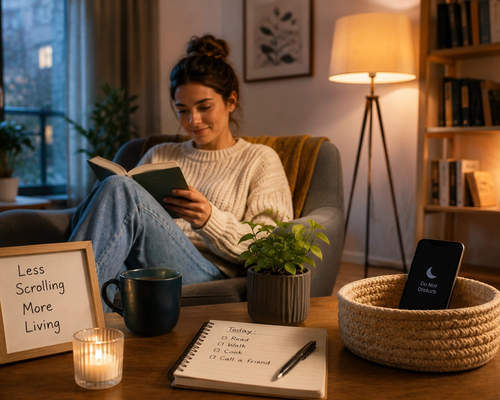
Calm online users create stopping points, whether intentionally or simply through routine. They put the phone down during dinner. They stop answering work messages at a certain point. They read before sleeping instead of scrolling until they can barely keep their eyes open. They allow themselves to be temporarily unreachable.
None of these habits require quitting technology. That is precisely why they are sustainable.
The goal is not to become someone who never checks social media, ignores messages, or knows nothing about what is happening online. It is to remember that connection does not require permanent availability.
The calmest relationship with the internet may be the simplest one: go online when you have a reason to be there, enjoy what is useful, and know when it is time to leave.

Attention rarely feels important while we are giving it away. We glance at a notification during dinner. We half-listen to someone while thinking about what we need to do next. We watch a film while checking our phones, walk through familiar streets without noticing them, and finish entire days unable to remember much of what actually happened.

We have become very good at recognizing lives that look interesting. They involve constant travel, impressive jobs, beautiful homes, busy social calendars, ambitious projects, expensive restaurants, dramatic announcements, and enough photographs to prove all of it happened. Online, an interesting life can start to resemble a continuous highlight reel.
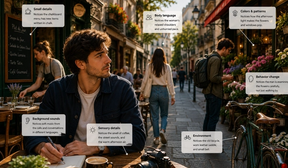
Some people seem to move through the world with a different level of resolution. They notice when someone has changed their hair slightly. They remember the name of the waiter from a restaurant they visited months ago. They spot an unusual building on a street everyone else has walked down a hundred times. They can tell when a friend’s mood has shifted before the friend says anything.

Sometimes you arrive somewhere completely unfamiliar and feel strangely at ease. You do not know the streets. You have no memories attached to the buildings. You may not even speak the language. Yet within a few hours, something about the place feels comfortable. You can imagine having a favorite café there, knowing which market to visit on Saturday, or walking the same route home every evening.

You do not need an expensive camera to take photographs worth keeping. The phone already in your pocket is capable of producing remarkably good images—and, more importantly, it is probably the camera you actually have with you when something worth photographing happens.

The internet is not something most of us can—or particularly want to—quit. We work online. We make plans through messages. We use maps, banking apps, calendars, news sites, music, podcasts, and group chats. Our phones contain genuinely useful tools alongside the apps that somehow turn five spare minutes into 45.