Why Some People Notice More Than Others
W
Walker York
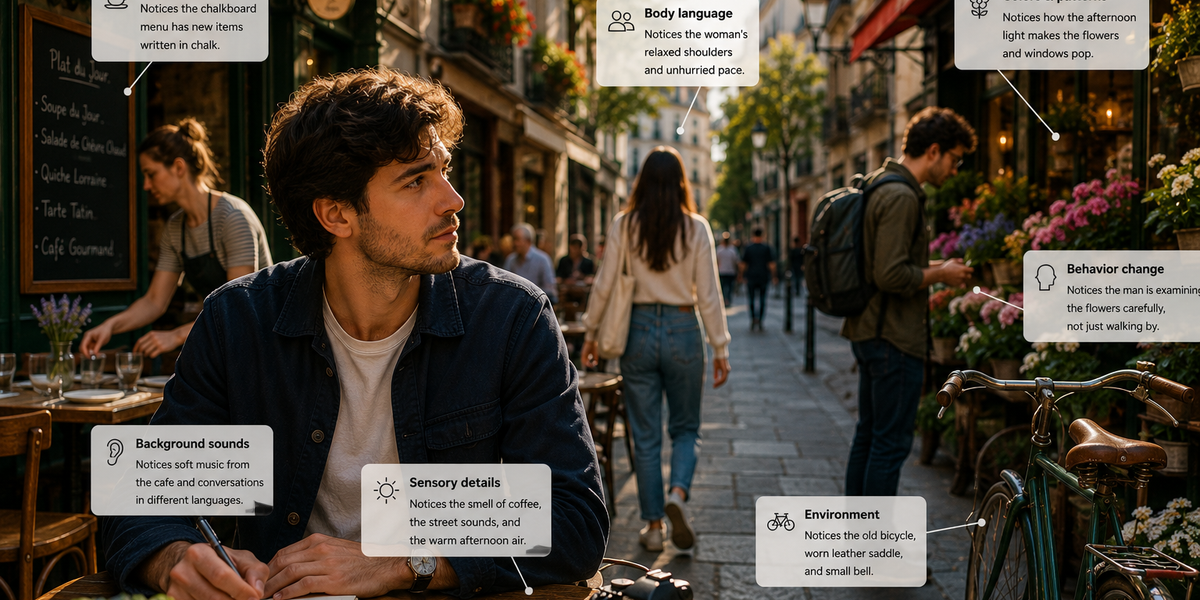

Some people seem to move through the world with a different level of resolution.
They notice when someone has changed their hair slightly. They remember the name of the waiter from a restaurant they visited months ago. They spot an unusual building on a street everyone else has walked down a hundred times. They can tell when a friend’s mood has shifted before the friend says anything.
It is tempting to assume these people were simply born more observant.
Sometimes personality plays a role. But noticing is also a habit. Attention can be directed, practiced, and strengthened. And the more carefully you look at the world, the more there seems to be to see.
This sounds obvious, but much of daily life happens on autopilot.
We walk familiar routes while thinking about work. We eat while checking our phones. We listen to someone while preparing what we want to say next. Our eyes are technically open, but our attention is somewhere else.
Observant people are often better at bringing their attention back to what is directly in front of them.
They look at buildings rather than simply navigating between them. They notice what people are wearing, what music is playing, how a room is arranged, or how the weather changes the appearance of a familiar street.
None of these details is particularly important on its own.
But together, they make the world feel richer.
It is much easier to notice something when you are interested in it.
Someone who loves architecture sees differences between buildings that another person barely registers. A gardener notices plants. A musician hears details in a song. A person interested in fashion notices fabrics, silhouettes, and small changes in style.
Knowledge creates more things to notice.
Once you learn the names of a few trees, a forest stops being simply a collection of green objects. Once you understand a little about coffee, different cups begin tasting more distinct.
This creates a useful cycle. Curiosity makes you pay attention, attention teaches you more, and knowing more gives you additional details to notice.
Interesting people often seem unusually observant because they are unusually interested.
Noticing people requires a different kind of attention.
Someone can say, “I’m fine,” while their tone, expression, posture, or unusual quietness suggests something else entirely.
Observant people tend to register those inconsistencies.
They also remember small details from previous conversations. A friend mentioned an important meeting next Thursday, so they ask how it went. Someone once said they hated olives, and months later they remember while ordering food.
These gestures can seem almost magical to the person on the receiving end.
Usually, they are not the result of an extraordinary memory.
The information mattered because attention was being paid when it was first shared.
Silence creates room for observation.
When every spare moment is filled with conversation, music, podcasts, videos, or scrolling, there is less space to notice what is happening around you.
People who observe well often tolerate periods without additional stimulation.
They can sit in a café and look around. Walk somewhere without headphones. Wait for someone without immediately reaching for their phone.
That does not mean they spend their lives silently contemplating the universe.
It simply means boredom does not always need to be eliminated within five seconds.
When nothing is demanding your attention, attention becomes available for whatever is already there.
Speed narrows attention.
When you are running late, you notice what helps you reach your destination. When you are rushing through dinner, you notice whether the food has arrived. When you are trying to complete ten tasks, your mind prioritizes whatever helps you finish them.
This focus is useful.
But when rushing becomes the default, peripheral details disappear.
Slowing down even slightly changes what becomes visible. Walk instead of driving when practical. Arrive ten minutes early. Spend another minute looking at something interesting rather than immediately moving on.
You do not need to live slowly all the time.
You simply need enough unhurried moments for the world to become more than background scenery.
Our brains are extremely good at becoming accustomed to familiar environments.
You stop noticing the artwork hanging in your own home. You barely see the buildings on the route you take every day. Familiar faces become so recognizable that small changes can disappear.
One way observant people counter this is by noticing differences.
What changed?
Is the light different today? Did that shop always have a blue door? Is someone behaving differently than usual? Has a tree started flowering?
Looking for change forces the mind to reconsider things it normally categorizes as familiar and therefore uninteresting.
Suddenly, a street you have walked down hundreds of times becomes worth looking at again.
Observation and interpretation are not the same thing.
Imagine someone is unusually quiet during dinner. You might notice the silence and immediately decide they are angry with you.
But that is an interpretation.
They could be tired, distracted, worried about something unrelated, or simply quieter than usual.
Good observers are often better at separating what they notice from the story they create about it.
That makes their observations more accurate.
Instead of thinking, “He’s annoyed,” they might register, “He’s speaking less than usual.”
That small distinction creates room for curiosity rather than assumption.
Noticing is not exclusively visual.
A place has sounds, smells, textures, temperatures, and rhythms.
Think about arriving somewhere unfamiliar. You might notice the sound of scooters, church bells, birds, traffic, or a language you do not understand. A bakery changes the smell of a street. Humidity feels different on your skin.
These details become part of memory.
Often, years later, it is not the famous landmark that suddenly transports you back somewhere. It is a smell, a particular song, or the sound of plates and conversations from a restaurant.
Paying attention through multiple senses gives experiences more ways to stay with us.
You can deliberately become more observant without turning life into an attention exercise.
Choose one small thing occasionally.
On your next walk, notice doors. At dinner, pay attention to how the food smells before tasting it. When someone is speaking, resist checking your phone or planning your response.
When visiting somewhere new, spend a few minutes looking before photographing.
The point is not remembering every detail.
It is strengthening the habit of looking before moving on.
People who notice more do not necessarily live in more interesting places or have more exciting lives.
They simply collect more from what happens around them.
They see the expression that lasted half a second. They hear the joke from the next table. They notice the first warm evening of spring and the way a familiar neighborhood looks after rain.
Most of these moments will never become important.
That does not make them meaningless.
A life is made from thousands of ordinary details, most of which disappear almost immediately.
Paying attention cannot preserve all of them.
But it can keep a few more from passing unnoticed.

Attention rarely feels important while we are giving it away. We glance at a notification during dinner. We half-listen to someone while thinking about what we need to do next. We watch a film while checking our phones, walk through familiar streets without noticing them, and finish entire days unable to remember much of what actually happened.

We have become very good at recognizing lives that look interesting. They involve constant travel, impressive jobs, beautiful homes, busy social calendars, ambitious projects, expensive restaurants, dramatic announcements, and enough photographs to prove all of it happened. Online, an interesting life can start to resemble a continuous highlight reel.
Some people seem to move through the world with a different level of resolution. They notice when someone has changed their hair slightly. They remember the name of the waiter from a restaurant they visited months ago. They spot an unusual building on a street everyone else has walked down a hundred times. They can tell when a friend’s mood has shifted before the friend says anything.

Sometimes you arrive somewhere completely unfamiliar and feel strangely at ease. You do not know the streets. You have no memories attached to the buildings. You may not even speak the language. Yet within a few hours, something about the place feels comfortable. You can imagine having a favorite café there, knowing which market to visit on Saturday, or walking the same route home every evening.

You do not need an expensive camera to take photographs worth keeping. The phone already in your pocket is capable of producing remarkably good images—and, more importantly, it is probably the camera you actually have with you when something worth photographing happens.

The internet is not something most of us can—or particularly want to—quit. We work online. We make plans through messages. We use maps, banking apps, calendars, news sites, music, podcasts, and group chats. Our phones contain genuinely useful tools alongside the apps that somehow turn five spare minutes into 45.