The Real Reason Memes Spread So Fast
G
Gilbert Ellis


A celebrity makes a strange face during an awards show. Someone takes a screenshot. Within hours, that face is being used to describe everything from opening your electricity bill to realizing you forgot to reply to a message three days ago.
By the following morning, you may have seen 20 versions of it.
Memes move through the internet with astonishing speed. Some disappear almost immediately, while others survive for years, constantly being edited and reused for new situations. Their success is not simply because they are funny. Plenty of funny things never become memes.
The memes that spread fastest tend to combine several powerful ingredients: familiarity, emotion, simplicity, participation, and perfect timing.
A good meme requires almost no explanation.
One image and a few words can communicate embarrassment, frustration, excitement, jealousy, exhaustion, or a painfully specific social experience.
That efficiency is perfect for the internet.
Instead of writing a paragraph about how it feels to receive a work email at 4:59 p.m. on Friday, you can send someone a familiar reaction image. The other person understands immediately.
Memes function almost like a visual shorthand.
Once people understand the format, the image itself carries part of the meaning. The caption only needs to provide the situation.
This makes memes unusually easy to consume in environments where people are scrolling quickly and deciding within seconds whether something deserves their attention.
Many successful memes are built around an oddly specific experience.
Opening the fridge repeatedly despite knowing nothing new has appeared. Practicing an argument in the shower. Saying “you too” when a waiter tells you to enjoy your meal.
These moments are mundane enough that people rarely discuss them. Then someone turns one into a meme and thousands of people think: Wait, everyone does that?
Recognition is rewarding.
We like discovering that our strange little habits, frustrations, and insecurities are not uniquely ours. Sharing the meme becomes a way of saying, “This is me,” without needing to explain yourself.
That is why relatability is such a powerful engine for sharing.
The more people who can see themselves in a joke, the larger its potential audience becomes.
A traditional joke usually has a relatively fixed form. A meme is often more like a template.
The image stays the same while the caption changes. A phrase gets reused in completely different situations. A video format is copied by thousands of creators, each adding their own variation.
That flexibility is crucial.
People do not only consume memes. They participate in them.
One person creates the original joke. Someone else adapts it to office life. Another makes a version about parenting. Another applies it to football, university, dating, politics, or a television show.
Every adaptation introduces the format to another community.
The meme spreads not because everyone repeats exactly the same joke, but because people keep rebuilding it.
When you send a meme to a friend, you are often doing more than showing them something funny.
Sometimes you are saying, “This reminded me of you.”
Or, “This is exactly what we were talking about.”
Or simply, “We both understand this.”
Memes help maintain relationships in tiny, low-effort ways. You may not have time for a long conversation with someone, but sending them a ridiculous video keeps a small thread of connection alive.
Friend groups also develop their own meme languages. Certain images, phrases, or jokes become funny because of shared history rather than because the original meme is particularly clever.
In that sense, memes are not merely content.
They are conversation.
A mediocre meme posted at exactly the right moment can spread further than a brilliant one posted two weeks later.
When something happens during a major sporting event, television finale, celebrity interview, or cultural moment, people immediately start looking for ways to react to it.
Memes provide those reactions.
The first few strong formats can spread rapidly because millions of people are already paying attention to the same event. Everyone understands the context, so creators do not need to explain much.
But this also gives many memes extremely short lives.
Internet culture moves quickly. Yesterday’s reference can feel ancient surprisingly fast.
The memes that survive longer usually become detached from the original event. People begin using the format even if they no longer know where it came from.
Normally, hearing the same joke repeatedly makes it less funny.
Memes sometimes work in the opposite direction.
A format can become funny precisely because everyone has seen it too many times. People start making deliberately ridiculous variations. Then they make jokes about the meme itself. Eventually, understanding all the layers becomes part of the humor.
This creates a kind of shared internet literacy.
Recognizing an old format signals that you understand the reference. Recognizing a particularly obscure variation signals that you are even deeper inside the joke.
Memes therefore create small cultural communities, sometimes lasting only days.
Social platforms reward content that produces quick reactions.
Memes are exceptionally good at this. They are easy to understand, easy to like, easy to comment on, and especially easy to share.
When people respond quickly, platforms may show the content to more users. Some of those users share it again, introducing it to entirely different networks.
The process can accelerate rapidly.
And because creating a variation requires relatively little time, hundreds of new versions can appear while the original format is still gaining momentum.
By the time traditional media notices a meme, the internet may already be getting bored with it.
Perhaps the most interesting thing about memes is how quickly ownership becomes blurry.
Someone creates an image or joke, but once it becomes a recognizable format, thousands of people begin adapting it. The meaning evolves collectively.
That makes memes unusually suited to internet culture.
They are fast, participatory, emotional, referential, and endlessly editable. They allow millions of strangers to briefly participate in the same joke while still making it their own.
Most memes will disappear.
But for a few hours, days, or years, the successful ones give enormous groups of people a shared language.
And sometimes all it takes is one badly cropped picture and exactly the right caption.

Attention rarely feels important while we are giving it away. We glance at a notification during dinner. We half-listen to someone while thinking about what we need to do next. We watch a film while checking our phones, walk through familiar streets without noticing them, and finish entire days unable to remember much of what actually happened.

We have become very good at recognizing lives that look interesting. They involve constant travel, impressive jobs, beautiful homes, busy social calendars, ambitious projects, expensive restaurants, dramatic announcements, and enough photographs to prove all of it happened. Online, an interesting life can start to resemble a continuous highlight reel.
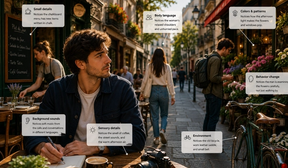
Some people seem to move through the world with a different level of resolution. They notice when someone has changed their hair slightly. They remember the name of the waiter from a restaurant they visited months ago. They spot an unusual building on a street everyone else has walked down a hundred times. They can tell when a friend’s mood has shifted before the friend says anything.

Sometimes you arrive somewhere completely unfamiliar and feel strangely at ease. You do not know the streets. You have no memories attached to the buildings. You may not even speak the language. Yet within a few hours, something about the place feels comfortable. You can imagine having a favorite café there, knowing which market to visit on Saturday, or walking the same route home every evening.

You do not need an expensive camera to take photographs worth keeping. The phone already in your pocket is capable of producing remarkably good images—and, more importantly, it is probably the camera you actually have with you when something worth photographing happens.

The internet is not something most of us can—or particularly want to—quit. We work online. We make plans through messages. We use maps, banking apps, calendars, news sites, music, podcasts, and group chats. Our phones contain genuinely useful tools alongside the apps that somehow turn five spare minutes into 45.